Friday, 28 August 2015

THE ECONOMIC SITUATION - AUGUST 2015

...

"You don’t need to be Paul Krugman to know the new normal is:

Anemic global trade; 

A severe crisis in most emerging markets; 

Europe's absolute stagnation cum recession; 

And 'factory of the world' China selling less to the rest of the world."

THE TRUE ECONOMIC SITUATION - Pepe Escobar of Asia Times.

"Meanwhile, the hyper-valued US dollar is strangling US exports; up to 3 percent decline in the first semester alone. Imports also fell by 2.2 percent; and that ties in with the structural corrosion of America’s dwindling middle class spending power.

"Everywhere we look, the whole structural landscape screams crisis of the neoliberal disorder."

THE TRUE ECONOMIC SITUATION - Pepe Escobar of Asia Times.

"Contrary to Western forecasts/wishful thinking, China is not imploding.

"Credit Suisse has released some quite level headed analysis. Here are the highlights.

"'China still has a very healthy current account surplus, its capital account is still partly closed and its major financial institutions are largely state-owned. 

"These factors combined would allow the monetary authority a free hand to create liquidity in the system if it wants to do so...

"'The fear of a repeat of the 1997 Asian financial crisis or a 2008 global financial crisis is not warranted.'"


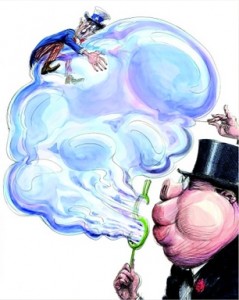
Illustration by Erik T. Johnson - The Stock Market and the Economy's Apparent Disconnect

"What to do about the tsunami of foreign money driving the US dollar up, and driving US industry to become totally uncompetitive...

"Central banks absolutely love to drive up stock market prices for the benefit of the 0.0001 percent.

"So expect more delusion ahead.

"But be sure everything that's solid melts into air. Including the neoliberal dream."

THE TRUE ECONOMIC SITUATION - Pepe Escobar of Asia Times.


The Central Banks have engineered this Financial Collapse, according to James Corbett

The Corbett Report 25 August 2015

"The phony baloney stock markets, manipulated as they are from top to bottom and juiced as they are on the Fed’s QE heroin, are no longer reflective of economic reality.

"The only question is how far this particular dead cat market will bounce, and whether it will be helped along with more heroin from the Fed..."

The Corbett Report 25 August 2015
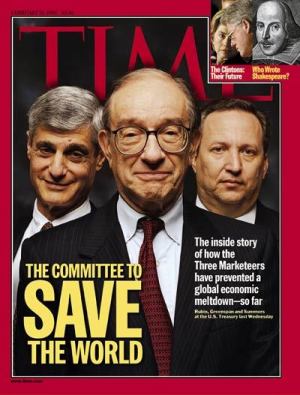


"This crisis was engineered by the central banks...

"It is the central banks that have created this mess, and what’s more they have created this mess in the full knowledge that their actions would lead to disaster.

"And now, one can be sure, the same central bankers and their political puppet mouthpieces will use this crisis to continue the construction of the New World Order that they called for in the wake of the 2008 collapse.

"Anyone who can’t see the endgame now - global government by the bankers, of the bankers and for the bankers - is either blind or wilfully ignorant...

"We can already see a false narrative underway. This narrative has two main thrusts: one is to paint China as the culprit for the global downturn and the other is to assume that only central banks can save the day (with even greater liquidity injections and even deeper rate cuts)."

The Corbett Report 25 August 2015


"I have just been on a swing through the North and East of the USA, and have talked to some of the leading financiers of the country.

"All the wealth of the United States has gotten into the hands of about five thousand families and their connections. 

"You know, if something is not done pretty soon to get this money out of cold storage, we're going to have the doggondest panic this country ever saw." 

Labels: , , , , , , , , ,

Wednesday, 8 October 2014

UNGER ON OBAMA AND THE WORLD

..

Roberto Unger is a 'Brazilian' philosopher whose theories are an alternative to neo-liberalism, Marxism and social democracy.

He believes that 'the market', the state, property rights, liberal democracy and 'wage labour' are all human inventions rather than something 'natural'.

He was one of the founding members of the Brazilian Democratic Movement Party, which is linked to the feudal oligarch Jose Sarney.

Roberto Unger's mother, Edyla Mangabeira, was a Brazilian journalist.

Roberto Mangabeira Unger - Wikipedia


..

Roberto Unger's German-born father, Artur Unger, arrived in the United States as a child, and became a naturalized citizen and a successful lawyer.

Roberto Unger appears to have certain ideas in common with THE GERMAN FRANKFURT SCHOOL

Roberto Unger attended the private Allen-Stevenson School in New York.

When he was 11, his father died and Unger and his mother moved back to Brazil.

In Brazil, Roberto Unger attended a Jesuit school.

He was then admitted to Harvard Law School and later taught there.

One of Unger's students was Barack Obama.

Roberto Mangabeira Unger - Wikipedia


Unger

Unger argues that we are free to choose and to create the forms that our societies will take.

Unger looks at how people create wealth to pay for violence, and employ violence to garner wealth.

..

In the above video, Unger suggests key policies to deal with the current economic situation:

1. Banks should be in the service of the people who produce goods and services.

Governments should tax and regulate the banks that do not contribute to production.

2. Use government money for 'venture capital' funds.

Supporting small and medium enterprises.

3. Reject government regulation and state controlled models.

Support cooperation between government and firms.

Support cooperation and competition among firms.

4. Support schools that teach general concepts and flexibility, not job-specific skills.


Unger receiving a medal of honor on Army Day 2008 from President Lula for his work in formulating Brazil's National Defense Strategy.

Unger states that there are only two models for a national economy available to us today:

A. The US model where BIG business controls the government

B. The model where BIG government bureaucrats control the economy.

Unger offers a third model that involves SMALL businesses.

Unger's model is 'decentralized, pluralistic, participatory, and experimental'.

This means an economy encouraging small business development and innovation that would create large scale self-employment and cooperation.

The emphasis is not on the protection of big business, but the highly mobile and innovative small firm.

Unger wants ordinary people to be involved in public services and care.

This would entail empowering each individual to have two responsibilities, one in the productive economy and one in the caring economy.


Unger

When it comes to politics, Unger wants:

1. The public financing of campaigns, rather than campaigns financed by oligarchs.

2.  People given free access to media outlets.

3. The party in power to find it easier to push through proposals and reforms.

And the opposition parties to find it easier to dissolve the government and call for immediate elections.

4. Any segment of society to be able to opt out of the political process and to propose alternative solutions for its own governance.

5. The state to have the power to rescue oppressed groups that are unable to liberate themselves.

6.  People to be directly involved in their local and national affairs.

According to Unger - while institutions do exist and shape our beings and our interactions, we can change both their structure and the extent to which they imprison us.[64][66][67]

A new moment in religion will begin, Unger argues, when we stop telling ourselves that all will be fine and we begin to face the incorrigible flaws in human existence.[8][64]

Unger would appear to be an atheist.


Roberto Mangabeira Unger.

In 1983, the governor of Rio de Janeiro appointed Unger to head the State Foundation for the Education of Minors (FEEM), a state-run foundation for homeless children.

During his year-long tenure, he opened the door to international adoption and reintegrating children with their families.

He also set up community organizations in the slums to help support families in order to prevent the abandonment of children.[83]


Minister Unger speaking to President Lula in 2007.

Unger wrote articles calling the government of President Lula "the most corrupt of Brazil's history" and called for his impeachment.[89]

Lula then appointed Unger as head of  the Ministry of Strategic Affairs.[90]

Unger saw the future in small enterprises and advocated a government run venture capital fund.

He supported the expansion of credit to smaller producers and a decentralized network of technical support centres that would help broaden the middle class from below.[91]

Unger worked with unions to write new labour laws designed to protect and organize temporary workers, subcontractors, and those working in the informal economy.[96]


Unger touring the Amazon via small aircraft

Unger and Mexican politician and political scientist Jorge Castañeda Gutman assembled an informal network of politicians and business leaders dedicated to redrawing the political map.

They floated proposals such as guaranteeing every citizen "social rights" (e.g. education and a job), breaking up media oligopolies, and holding town meetings to help citizens supervise municipal spending.

Their meetings resulted in a document entitled the "Buenos Aires Consensus" in 1997, which Castaneda called "the end of neoliberalism; of the Washington Consensus."[103][104]

This consensus was formally signed in 2003 by Argentinian President Néstor Kirchner and Brazilian President Lula da Silva.[105]

Labels: , , , , , , , , , ,